After
harvesting my willow beds during the dormant period, I used almost all of this years rods for propagation.

These are samples of cuttings from a few varieties, ready to be planted.
I made a total of 7600 cuttings that were stored in closed plastic bags (to prevent them from drying out) in our dark garden shed until it was time for me to plant in the field.
Willow bark contains a natural growth hormone making it very easy to propagate willow from hardwood cuttings which produces plants of each variety with exactly the same genes as the mother plant. It is particularly beneficial when growing willow for weaving to know what the plant's characteristics are and willow weavers around the World all have their favourites.
I have chosen to mulch the willow field for two reasons. First, the plants can't compete with weeds during the first couple of growing seasons and our soil being heavy clay, it is not possible for me to weed mechanically around their new, shallow roots. The second reason being the new plants' need for moisture until roots have developed and the plants are well established. Since I started my first willow beds, I have used different kinds of mulch. First I used a
geo-textile, only to find out that it wasn't dark/thick enough to prevent weeds from growing underneath it. The weeds were growing very well, competing with the willows and by mid-summer I had to cover the textile with grass cuttings.

This is a Black Maul cutting with new shoots - the competing weeds underneath the mulching
geo-textile.
So last year I made a larger investment in a woven poly-cover (the kind nurseries use for ground cover in display areas) as this was recommended to me by another willow grower. Just like the
geo-textile water and air were able to pass through the cover to benefit the plants. It seemed to be the perfect solution until later in the season when the faster growing varieties started to get strangled by the weave. The plants were not harmed, but after harvesting this spring I started to make cuts around each plant (about 1500) as most had a thread or even a "piece of cloth" embedded in the growth.

Cutting holes in the poly-cover will allow weeds to grow around the willows. I hope however, that the plants are big enough this year to quickly produce shade to
out compete the weeds.
This year I used left over material from last year and then bought a heavy plastic from a greenhouse/nursery supplier. It is common to use black plastic for this purpose, but I was afraid that with the high temperatures during summer, the new roots of the plants would get fried. The plastic is black on one side and white on the other so we put it down, white side up which will reflect the sunlight on the plants.
INFORMATION ADDED LATER: Do not put the plastic down with the white side up. It will reflect the sun and make it too hot for the plants. Place it with the black side up!

The cuttings are planted before, or just as they break dormancy and these were planted on April 19, 2009. In this photo from May 1st new shoots are visible on almost 100 % of the cuttings. That's exciting - it doesn't mean that they have rooted already, but they are alive and have enough energy stored to start growing and rooting.
I'll have to admit that my main reason for all this willow stuff is a plan to be able to run a willow based business with the raw material coming from my own field.
And that is a LONG-TERM commitment............
I started in the spring of 2007 and it will be at least another couple of years before I will have enough material to work with. As time goes by, those of you who are interested will be able to get more information on the web-site that I will be setting up in a few months.


 The Pickerel Weed (Pontederia condata) didn't disappoint with lots of beautiful blue flowers attracting a variety of insects for a few weeks now.
 The flowers of Arrowhead (Sagittaria latifolia) have also been a delight along with it's beautiful "arrowhead" leaves.
 The leaves of the Broad leaf Water Plantain (Alisma plantago-aquatica) resemble the well known (annoying weed) plantain, just much larger, but the flowers are quite different. Tiny, white flowers on a large, very "bushy" stem. Really not that spectacular.
 We have lots of frogs in and around the pond - green, brown and leopard frogs - but they usually jump into the pond as we get closer. A "frog" noise and a splash, but one day, when the water level was lower, I was lucky to get a glimpse of this guy.
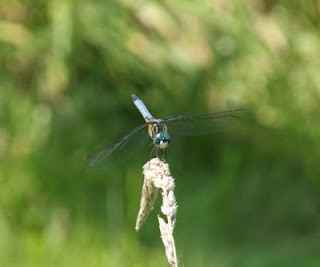

 I would have liked to capture one of the big ones flying - they are just like tiny helicopters!


 My harvest of 'Americana' on the other hand, was all cut up for propagation and I planted 1500 new plants.
 I am quite happy with the new plants in the field as most are growing well. 'Americana' is not the most vigorous variety the first year - but they are not the slowest either!
 A shoot showing off the beautiful bluish, grey leaf colour of the 'Americana'.
 The
The  Verbena
  I transplanted the first 10 of
  The native Aster
  Digitalis
 Some species/varieties seem to be doing well, but stay small as this

 Winter sowed

 The willows in the field are doing great. Looks like almost 100% of this year's plantings are growing well and not - so far - any signs of deer stopping by for munchies.
 The European Beech (
 I believe that the
  Another favourite bloomer is the Siberian Iris (Iris
  I never liked most rose bushes - I think the plant itself is ugly - but those flowers!! There are many beautiful (and also some climbers whose "frame" is good looking too), but I will choose the
  Not much as soothing with the ability to make me feel good as my meadow (hey field) with different grasses, clover,
  I can't pick just one, but here is a lovely summer pic of the early plumes of my Pampas grass (I think - but I don't know for sure) on a sunny summer day last year.
 Looks like he is really eager to explore the world again.


 Posts
Posts


