Showing posts with label winter colour. Show all posts

Monday, December 23, 2013

Hello to the New Year 2014

2013 was an exciting year here at Lakeshore Willows with workshops and new developments.
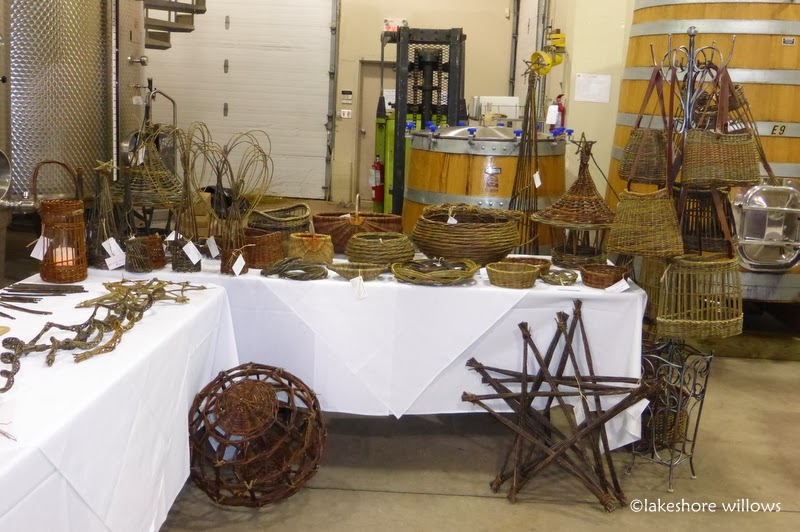
Now that the Christmas markets, events and workshops  are done - the photo above is from the Christmas event at Vineland Estates Winery in December - and as the year is coming to an end, it is time to make some plans for 2014.


The garden globe has been popular at workshops here and is offered as a project to do at a one-day workshop again next year.
For other workshop projects available check out "Workshops and Events"
In January and February a workshop on the Tatza basket is offered at Vineland Estates Winery in combination with a delicious lunch at the winery restaurant and also winery tour and wine & cheese pairing seminar. Scheduled dates are January 25th and February 22nd. Further information to be announced at our website and also at Vineland Estates Winery's website.


From lush and green to naked with changed colour palettes the willow is now ready to be harvested. We expect to start sometime in February - weather dependent - and living willow for propagation and living willow structures will be available after harvest. 
Orders are coming in and filled as received for shipping later in winter/early spring after harvest.


A few workshops have been scheduled for January, February, March and April and information can be found on my website www.lakeshorewillows.com under "Workshops and Events".
In addition to that we are very excited about willow basketry classes in May and June with 3 of Denmark's most talented, internationally known willow artists.
Detailed information about these classes will go out in a newsletter in January as well as being posted here at the blog and on the website.
In the meantime I wish you all a very Merry Christmas and a very Happy New Year 2014.
Words and photos by Lene Rasmussen,Willows.
Monday, September 10, 2012

Planting willow in your garden for colour?

It is not unusual to find articles in gardening magazines showing the very colourful stems of willow in the wintertime and most often the featured willows are varieties or hybrids of “white willow”, Salix alba.
Here are a few pointers that are often overlooked.
First of all it is ONLY the growth from the previous growing season that has colour. If you leave your willow shrub unpruned, you will end up with a large shrub with a few small, colourful tips during winter. Therefore – to really get a beautiful colour display you should coppice (cut down to the ground) the plants late winter/early spring as they will grow long shoots during one growing season and they will all have coloured bark. To make a real statement you could plant several plants of the same variety close together (about 30 cm/1foot apart). If you have a small garden and are worried that planting several willows will be too much for your other plants, you can repeat the coppicing (cutting down to the ground) in early summer. Supposedly (and I say that because I don’t have any personal experience/knowledge of this, but have read about it) the willow will not develop a large root if it has to use energy on new growth once or even twice annually.
In my opinion it is not only for winter colour that you plant willow in the garden. Many of the willows have very beautiful foliage, form and colour throughout the year. To illustrate this I have found a few photos:
I will start with Salix x ‘Flame’ as that one is often mentioned as a candidate for winter colour.100_3246By the time the leaves drop off, the bark has developed some colour that will intensify as the weather gets colder.
Flame June 2, 09 Salix x 'Flame', July 3, 2012 'Flame' July 3, 2012 3 
Salix x ‘Flame’ has beautifully coloured leaves in spring and early summer and the stem colours will vary from a light greenish/yellow/orange to a darker reddish brown. The two photos marked July 2012 are of the same plant, but photographed from the North and South sides of the plant. The more sun that the plant gets the darker the colour during the summer and these stems are darker on one side than on the other.
Another willow that has been planted in a lot of gardens during the last few years is the dabbled willow, Salix integra ‘Hakuro Nishiki’. A large shrub with pink shoots can look very beautiful, but as you can see on the following photo this willow can also be planted in your mixed bed, coppiced annually and it just looks lovely.
Salix integra 'Hakuro Nishiki'  Nishiki Oct 29, 09

The variegated leaves are beautiful and the tip of the branches continue to be of an almost coppery colour during the summer. After the leaves have dropped the stems on this willow is a paler reddish brown.
One of my favourite willows (I have quite a few) is Salix koriyanagi ‘Rubykins’. It grows tall and slender one year rods when coppiced at the end of winter.
Salix koriyanagi 'Rubykins' Rubykins single stem Sept. 1,09 Rubykins tip, Sept 7, 09 Rubykins, May 1, 2009
The very first leaves in spring are an incredible coral/peachy colour. Later the leaves are darker green, but the tips of the branches remain very colourful as you can see on the photo. Maybe that explains the name ‘Rubykins’? The last two photos show the light green colour of the stem. That is also the colour that the stems have during winter.


The last variety featured today is Salix x acutifolia
  Salix x 'Acutifolia' July 3, 2012 Harlequin acutifolia foliage Aug 5, 09 New shoot, acutifolia tree
100_3529
The winter colour of acutifolia is a very unusual and pretty dark purple that gets a bloom – a whitish waxy covering. If the plant is not coppiced the colour of the two year old branches will look almost as if they have been white washed. On the second photo you can see the red stems on the new growth and at the bottom of the photo you can see the two year old whitish stems (it is a braided Harlequin tree)

Sunday, January 29, 2012

Taking orders for Willow cuttings and rods 2012


The winter - so far - has been mild with weather conditions changing almost daily. During January we had temperatures ranging from 15 degrees Celsius to -17 (+ the effect of the wind chill), sunny days, rainy days, snowy days, very windy days and a few days like today starting out looking like a dense snowstorm, then suddenly more and more blue appearing in the sky with bright sun and temperatures just above freezing. The snow probably won't stay long this time either.

These conditions have made it possible for us to start harvesting the willow already and we are now taking orders for willow cuttings and rods. Delivery can take place anytime you wish until the end of April. If you order - and receive cuttings before you are ready to plant them - don't worry, they will keep just fine wrapped in dark plastic and stored in your fridge. Prices and information about availability and kits for living willow trees can be found at the top of the page under "Cuttings and whips"!

The fairly wet snow coming down this morning blanketed and hugged the willow in the garden. Beautiful!

The smaller willow Salix eleagnos (often called rosemary willow, but it is not Salix rosemarinifolia) has narrow green leaves resembling the leaves on rosemary. Cuppiced each year the shrub grows to a height of about 75cm (under 3 feet) and I grow some as a low, natural hedge. The winter bark on S. eleagnos i very dark  brown almost black with dark red bud scales.

The trunk of the woven willow trees lend themselves to some beautiful snow covered images. Salix x acutifolia is a more vigorous willow, its first growth in spring a bright wine red with almost lime coloured new leaves. Later the foliage colour gets a bit darker, but the branches stay a wine red colour during summer. As the leaves fall the colours of the bark change to a dark purple, almost black. The following year the bark on last years growth develops a bloom that gives them a whitewashed look. Older bark  is black as seen on the image on left. The branches on the image to the right show winter bark on one year old shoots. 

A woven or twisted tree looks especially
beautiful in this variety of willow and grown as a shrub in the garden it ads beautiful colour year round. 

Salix alba 'Sericea' has intense dark orange coloured  winter bark. As other alba hybrids it tends to grow with lots of side branches (even when coppiced) so it is not the best willow to grow for basketry. It is great though, to have a few bundles of rods to ad some colour variations to certain baskets. For that purpose I have to cut the side branches off for use as weavers - and I only get a few for my own use. It is far too much work!

Living willow fence in snow.

Words and photos by Lene Rasmussen,Willows.

Thursday, December 22, 2011

December willows

Running late seems to be the thing for me in December. This week I finally made my winter planters - just have to ad some lights now.

Inspired by a customer who bought some willow globes from me for her planters, I have placed globes on top of a bed of greens in my planters at the back door. My customer has added strands of lights to her globes and it looks beautiful at night - I may just do that also, if I can find the time for it before Saturday that is. 

For the front door I have used lots of curly willow and dragon willow branches for a look similar to last year.

So far this winter we have only had a couple of days with snow. When we get the snow, however, it always gets caught by the willow in the field and I end up with large, deep drifts of snow among the willows - snow that doesn't melt till long after all the other snow is gone - and I scramble to get the willow harvested before it goes out of dormancy again and the bark loosens from the rods.
This year we have put a snow fence up hoping that most of the snow - if we get a lot - won't get caught up in the willows and I will be able to harvest earlier.
I could harvest at any time now, but am waiting for some frost so that it isn't so wet and muddy in the field and we can bring out the tractor to transport the willow to the barn.

The colours of the willow in the winter always amazes me, so diverse and vibrant.

Today is the shortest day of the year - we're on our way towards spring!
Wishing all a wonderful Christmas and a very Happy New Year.

Words and photos by Lene Rasmussen,Willows.

Tuesday, April 13, 2010

Willow harvest and the beginning of a new season

I finished harvesting a couple of weeks ago and I sorted the willow for different purposes.

The rods for drying for future weaving projects are sorted and bundled to be placed in the barn for drying over the next few months.

The large rods to be used for living willow projects - as the woven fence in the picture here and my various trees - were wrapped in black plastic and stored in the shade on the North side of the barn to prevent them from drying out and make sure they stay dormant. More to come soon about my workshops and the woven fence (also called a fedge).
Then, as I prepared for my workshops , I placed the bundles in buckets with their feet in water - still in the shade - Here are some of the Salix koriyanagi 'Rubykins', the rods up to 2.5 meters (8 feet) long, no branching and perfect for making the Harlequin tree.
As the majority of my willows were planted last spring, and most willow varieties don't grow the long, unbranched rods the first year, I had a big pile of branches that were not good for my above uses. I will play with it a bit to find use for some of it and maybe part of it will end up on a bonfire.
Spring is here and I am so pleased to see that the willow in the field is starting to show new growth. In a few weeks I will be posting photos from the field with beautiful colours. Even the very new and small shoots look quite different on the different varieties.          
The potted trees that i have at the front door started to leaf out a couple of weeks ago and by now they look like this. The wine red stems of Salix x acutifolia get a greyish-white bloom during their second year and after that they turn almost black. Very interesting and beautiful variety. It is great for living willow projects, but not very good for weaving as it is not very flexible.
Words and photos by Lene Rasmussen,Willows.


Thursday, February 18, 2010

Salix alba x for winter colour

The third post in a series about my willows is about Salix alba, White Willow and some of its hybrids.
The many varieties and hybrids of Salix alba offer beautiful "sunshine" colours for the winter garden.
Salix alba 'Chermesina' click image to enlarge

Salix alba 'Chermesina', Redstem willow truly lights up in a snow filled landscape. These photos from March 2009 show plants planted from cuttings in April 2008. The bud scales are flat and yellow.
The bright yellow-orange-reddish colours are unique to the newest growth on a dormant willow plant. As I coppice (cut down to the ground) my willows every year, they will always show colour on the whole plant during winter. When the plant is left un-pruned the colours will slowly change to brown and only the newest growth will show colour during the dormant season.
Salix x 'Flame' click image to enlarge

The new growth on 'Flame' in early summer is very pretty with red stems and orangey-red tender leaves, but during the summer the plants turn rather dull with light greenish-yellow branches. As the plants prepare for dormancy, they start to take on the fiery colours.
Salix x rubens 'Hutchinson's Yellow' click image to enlarge

Salix x rubens, Hybrid Crack Willows, are hybrids between Salix alba and S. fragilis and they hybridize readily in nature.
The seasonal changes for 'Hutchinson's Yellow' are very much the same as for the above 'Flame' and they both have beautiful red bud scales on the dormant rods. Looking at the plants up close, it is difficult to tell the difference. From a distance, however, the overall winter colouring is darker, reddish for 'Flame' and more yellow, orangey for 'Hutchinson's Yellow'.
Salix x 'Red Corkscrew Willow' click image to enlarge

The corkscrew willows have become very popular for floral arrangements and are available at most floral suppliers. If you'd like to grow your own, it is very easy and you don't need to have space in your garden for a big tree. When you coppice the plant in early spring, you'll end up with 5-7' long curly branches by fall and they will develop beautiful colour when dormant. There are different varieties yielding different colours.

Some Salix alba varieties have flexible rods and are also used for basketry. The yellow colours are attractive, often used for contrast although the colours change drastically during the drying and subsequent soaking of the rods. Sometimes the rods are woven before they are completely dry and still flexible enough for weaving which often results in work keeping more of the original colours.

Words and photos by Lene Rasmussen,Willows.