Sunday, September 20, 2009

From seed to bloom first season - perennials

The new perennial bed is filling in with the plants that I grew from seeds this spring. It will take a couple of years until everything really has settled in and is able to block out most weeds, but I am quite happy (for now) - many of my plants have bloomed this first season:
The verbenas, poppies and daisies were the first to start blooming, already before they were transplanted to the garden.
The white poppy (papaver anomalum 'Album') is still blooming, but most of the plants are quite small and I hope that they will get stronger, larger by next summer.
Brazilian verbena (verbena bonariensis) has put up a non-stop show and I just love their colour and airy structure.
- and so do the Monarch butterflies.
Daisies have always been some of my favourite flowers - I would just wish that they had a much longer blooming time. I chose this double shasta daisy (leucanthemum maximum 'Crazy Daisy') and this first year their blooming season has been quite long, mostly because the individual plants decided to start blooming at different times.
This beautiful agastache (agastache foeniculum) also started it's purplish-blue flowers early in the summer - but ONE DAY AFTER we had this summer's heaviest rain they all died, drowned. My frantic digging of trenches didn't save these and a few more plants - darn!
Sitting right in the middle of the lowest spot and with their feet in water were the sneezeweed (helenium flexuosum) their happy little faces glowing. I'll ad some more heleniums next year to help fill in the bare spots in the bed.

Saved by the trench were the native Giant Blue Lobelia (lobelia siphilitica). A couple of them died, but most came back from their drooping state after I dug the trench.

Another native (you find it everywhere around the countryside this time of the year) the aster (aster puniceus) has bloomed and is now producing large amounts of seeds that will be spread by the wind.
Butterfly weed (asclepias tuberosa) bloomed although the plants are very, very tiny. After the butterfly larvaes have been there, there isn't much left - hopefully enough to carry the plants over till next year.
I didn't really expect any of the echinaceas to bloom this year, but the white variety Alba (echinacea purpurea 'Alba') has turned out a few blooms - although I have left them in small nursery pots to be transplanted to the garden soon. Looks like it was not just seeds from Alba in that envelope from the seed company.
With a little luck - and lots of work - I'll be able to post some beautiful images of the perennial bed next year.

Wednesday, September 2, 2009

Meme Award - What you don't know

I was pleasantly surprised when I was tagged by Yvonne Cunnington aka Country Gardener with this blogger's meme. I have frequented Yvonne's web-site "Flower Gardening Made Easy" for a long time and when I found out about blogging (just recently), Country Gardener was my first to follow and still the one that I cannot wait to check out.
Participating in this Meme Award you have to:
Link back to the person, who gave you the award.
Reveal seven things about yourself.
Choose seven other blogs to nominate and post a link to them.
Let each of your choices know that they have been tagged by posting a comment on their blog.
When your post is up, let the tagger know.
About me:
1.
I was born in a small town, Nykøbing Mors, in Denmark in 1953. My parents both worked in my father's meat shop, and literally, we all lived there. The ground level apartment in a small apartment building had been divided into two: the shop and the home, so even though my mother worked full time, she was always there. In that "half" apartment my parents had day beds in the living room, and the bedroom was shared by my older brother, me, and my younger sister. There was no garden, only a small paved yard at the back where we could play. Needles to say, we were all excited when my Dad bought a house with a garden by the time that I was 12.Most of my life was spent on the "sunshine" island Mors, where I lived like most small town dwellers, everyone knowing everyone.
2.
Much later I met the most wonderful (Canadian) man, got married (again) and moved to Canada in 1992. Between the two of us we have four wonderful children, Ann, Alice, Dea, and Mark, who today live "all over the World": Ann in Denmark, Alice in England, Dea (with husband James) in Sweden, and Mark in Ontario, Canada. I cannot help but thinking of how difficult it must have been for families emigrating many years ago when there was no telephone, e-mail, skype, "cheap" flights etc, all factors to make it easier to live far apart.
3.
Track and field was my favourite sport when I was at school. Later I started hiking and have participitated in 100 km long international hiking events in the Alps, hiking in Germany, Switzerland, and Austria. We were more than 100 people from Denmark travelling together by buses and staying at a youth hostel in Switzerland joining the large group of international hikers. For 6 years I went on the Bodensee trip and over the years I found many wonderful friends hiking.
4.
When I was 15 I had a summer job at a nursery. I started at 6 in the morning and worked till noon collecting tulip bulbs, crawling on my knees behind a tractor that was working the soil to loosen the bulbs. I stayed at my aunt and uncle that summer and I had to ride my uncle's moped for about one hour to get to the nursery. I was so proud and spent the money on a coat and winter boots made of the softest skin.
5.
I love cooking. I never make anything, but from scratch - probably because that was how I was brought up. My mom was an excellent cook, but working full time at the meat shop didn't make time for a lot of "extra" as bred making or baking cake and cookies. Her sisters were all outstanding cooks and I watched and sometimes "helped" when I was a little girl. So to me it is nothing special to have a home cooked meal every day and I always bake my own bread. A stable is Danish rye bread which is somewhat like the German dark, dense rye bread. It is made with a sourdough, and I ad lots of rye and wheat kernels as well as pumpkin seeds. This bread is sliced very thinly, and used for open face "sandwiches" - which you may know is a Danish specialty.
6.
As a teenager I listened to Danish as well as international pop and rock. And I was an Elvis fan! Today I enjoy classic rock, easy listening and light classical music. The radio is mostly tuned in on oldies, some easy listening, or sometimes the Danish radio (the computer is hooked up to our amplifier).
7.
I also love dancing. When the work schedule has allowed we have been taking dance lessons over the last few years. When my parents had a party at the house, they would be dancing and that's where I learned my first steps of polka, waltz, cha-cha, etc. Music and dance just make me happy.
Now for my seven nominees:
My friend, willow grower and weaver, Frances of Weaving Willow
Steve of Willow Basketmaker, who writes the blog about Katherine Lewis and Dunbar Gardens showcasing her craft and beautiful baskets.
JW of MacGardens whos posts are always interesting and with beautiful pics.
Linda of Tree and Twig Farm Blog for me a local farmer advocating buying locally grown food. Her web-site: Tree and Twig
Kathy of Skibby's Vegetable Garden at Kathy (with Skibby's help) you can find any information you could ever need growing a veggie garden.
Kathy Purdy of Cold Climate Gardening - whose blog posts I always enjoy.

Sunday, August 23, 2009

Pond Life

We have two ponds on our property. One is out in the field and serves as water reserve in case of fire as we do not have fire hydrants out here in the country.
The other one is smaller, not as deep, and closer to the house so it is more a part of our garden.
The first couple of years we just left it alone, but the cattail (Typha latifolia) growing in a neighbouring swamp just invaded the pond. We decided to introduce some "desired" native water plants and last year we purchased the following from Acorus Restauration:
Blue-flag Iris (Iris versicolor) was one of the first plants to bloom in the pond early June this year.
The Sweet-scented White Water Lily (Nymphaea odorata, N. tuberosa) has spread beautifully with lots of lily pads floating on the water and new blooms appearing all summer.

The Pickerel Weed (Pontederia condata) didn't disappoint with lots of beautiful blue flowers attracting a variety of insects for a few weeks now.
The flowers of Arrowhead (Sagittaria latifolia) have also been a delight along with it's beautiful "arrowhead" leaves.
The leaves of the Broad leaf Water Plantain (Alisma plantago-aquatica) resemble the well known (annoying weed) plantain, just much larger, but the flowers are quite different. Tiny, white flowers on a large, very "bushy" stem. Really not that spectacular.
Around the edge of the pond there's a variety of sedges and rushes, some of which we have planted and some just appeared. And then there's the residents and visitors:
We have lots of frogs in and around the pond - green, brown and leopard frogs - but they usually jump into the pond as we get closer. A "frog" noise and a splash, but one day, when the water level was lower, I was lucky to get a glimpse of this guy.
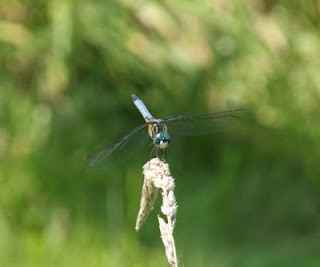
The dragon flies are amazing. We have green, blue, yellow-ish ones in all sizes.
I would have liked to capture one of the big ones flying - they are just like tiny helicopters!

Tuesday, August 11, 2009

Salix 'Americana'

In the spring of 2007 I decided to grow willows as I had an idea of building fences from willow-rods - and this will be the first of a series about my willows. (More about willow fences later).
Salix 'Americana' was introduced to Britain and Europe from North America where it is extensively grown for basketry and it was one of the five varieties I planted that year.
My first rows of Salix purpurea 'Streamco' and S. 'Americana'. 'Americana' is growing taller and 'Streamco' has somewhat finer rods. Both varieties are very flexible and grow long slender rods, most of which have no branching, and they are some of the willow varieties most willow weavers in North America and Europe know and use.
'Streamco' throws lots of rods from the base of the coppiced plants.
In 2008 'Streamco" produced from 10 to over 30 rods per plant - which I thought was a lot for their second year. All rods were dried as I decided not to plant new stock of that variety this year - so the coming winter I will be experimenting with some weaving.
My harvest of 'Americana' on the other hand, was all cut up for propagation and I planted 1500 new plants.
I am quite happy with the new plants in the field as most are growing well. 'Americana' is not the most vigorous variety the first year - but they are not the slowest either!
A shoot showing off the beautiful bluish, grey leaf colour of the 'Americana'.

Monday, June 8, 2009

Perennials from seed

The greenhouse is bursting with plants, some of them ripe for transplanting. Actually, some have been in their pots far too long so that by now they are pot bound and need to go in the garden very soon - or some of my hard work will be wasted. The Leucanthemum maximum 'Crazy Daisy' (Double shasta daisy) are rapidly filling in and they are thirsty constantly.
Verbena bonariensis (Brazilian verbena) are just as big and compact and screaming for more room.
I transplanted the first 10 of Aruncus dioius (Goatsbeard) last week-end as one of the beds that they are going in was cleaned up and mulched.
The native Aster puniceus (Purple stemmed aster) was almost "standing still" for some time, but the last couple of weeks really got them growing.
Digitalis stewardii (Foxglove) is the best looking of my three varieties. D. furreginea and D. parviflora didn't have a high germination % and are more or less just surviving. I think that I'll get a few of each, but this one is the best so far.
Agastache foeniculum (Giant blue hyssop) have done extremely well and also need to get a new home soon. Looks to me like a couple of seeds were from the golden-leaved variety?
Some species/varieties seem to be doing well, but stay small as this Heuchera villosa (Coral Bells),
Monarda fistulosa (Bee balm), and
Thalictrum pubescens (Tall meadow rue). I wonder if they would have looked different had I transplanted them into larger pots earlier, or are they just enjoying their youth as they don't have to rush to maturity like their annual cousins? I feel that they are too small to go into the garden and I will probably have to transplant them to either larger pots or a nursery bed until the fall or next spring.
In the green house, but not shown here are also Papaver anomalum 'Album' (White poppy), Euphorbia polychroma, Lobelia siphilitica (Great blue lobelia), Helenium flexuosum (Sneeze-weed), Sanguisorba officinalis (Great burnet), Liatris 'Floristan Violet' (Blazing Star), Asclepias incarnata (Swamp milkweed), Salvia superba dwarf 'Blue Queen', Salvia nemerosa, Phlomis tuberosa, Echincea purpurea 'Primadonna', E. purpurea 'Alba', and E. purpurea 'White Swan'.
It's all been fun and very exciting - although lots of work - to see the seedlings grow and flourish.
Winter-sowing however has been disappointing. Many varieties didn't germinate, some only had very few seeds germinate, and then some germinated and disappeared again before the seedlings grew big enough for transplanting.
Winter sowed Eryngium planum (Flat sea holly) had one seedling from a packet of seeds as did Sorghastrum nutans (Indiangrass).
Eupatorium maculatum and E. purpureum (Joe Pye) both germinated with 5-8 seedlings then died for me.
Angelica (Great Alexanders), Trollius europeanus (Globe flower), and a handfull of varieties from seeds I collected didn't germinate at all (yet?).
Sunflowers, Hollyhock, a double rudbeckia, echinacea, and shepherds scabiosa germinated well and are growing, although very tiny seedlings. Also germinating, but in small numbers were Astrantia major (Great masterwort), Trollius ircuticus (orange Globe flower), Asclepias tuberosa (Butterfly weed), Leucanthemum x superbum 'Alaska' (White daisy), and Rudbeckia 'Goldsturm'
I don't plan on growing this many seedlings again, but I am quite sure that whatever I grow, I'll get my grow lamps out in the office and then raise the seedlings in the greenhouse again. It may be a little more work, but with much greater results.

Wednesday, June 3, 2009

Bit off more than I can chew---

------hope not, but that is how I often feel these days!

After a loooong winter the grounds around here were wet, cold, and not workable until mid May by which time the weeds were far into the race to reach maximum height before the end of the month.

It is really not that I have been lazy (haven't even had time to enjoy most of my favourite blogs the past couple of weeks) - things just seem to all of a sudden to have gotten out of hand.

Think of myself as a pro-active person - at least during "normal" times - the gardening chores these days, however, have my mind and body jumping from one to the other, depending on which one appears to be most critical. It's like damage control - do I let the weeds take over totally while I get the veggie garden in order? - or do I spend my time on the jobs with the biggest impact letting my seedlings suffer as they need larger containers? - do I get my perennial beds ready for transplant of my seedlings (most of which will not bloom till next year) ignoring planning and planting the multiple containers that should be focal points on our new deck by the time we'll have about 100 guests here late July?

Happily I finished planting and sowing the veggie garden today. My tiny basil plants along with tarragon, parsley, rosemary, and the "perennials" sage, oregano, thyme, and chives in the raised bed.

The potatoes were sown 2 weeks ago and are showing some healthy leaves.
The willows in the field are doing great. Looks like almost 100% of this year's plantings are growing well and not - so far - any signs of deer stopping by for munchies.
I'll have to make some kind of "project plan": Lene's 2009 garden, step by step to stay focused (pro-active if possible) and save my sanity.

Tuesday, May 5, 2009

Propagating willow

After harvesting my willow beds during the dormant period, I used almost all of this years rods for propagation.These are samples of cuttings from a few varieties, ready to be planted.

I made a total of 7600 cuttings that were stored in closed plastic bags (to prevent them from drying out) in our dark garden shed until it was time for me to plant in the field.

Willow bark contains a natural growth hormone making it very easy to propagate willow from hardwood cuttings which produces plants of each variety with exactly the same genes as the mother plant. It is particularly beneficial when growing willow for weaving to know what the plant's characteristics are and willow weavers around the World all have their favourites.

I have chosen to mulch the willow field for two reasons. First, the plants can't compete with weeds during the first couple of growing seasons and our soil being heavy clay, it is not possible for me to weed mechanically around their new, shallow roots. The second reason being the new plants' need for moisture until roots have developed and the plants are well established. Since I started my first willow beds, I have used different kinds of mulch. First I used a geo-textile, only to find out that it wasn't dark/thick enough to prevent weeds from growing underneath it. The weeds were growing very well, competing with the willows and by mid-summer I had to cover the textile with grass cuttings. This is a Black Maul cutting with new shoots - the competing weeds underneath the mulching geo-textile.

So last year I made a larger investment in a woven poly-cover (the kind nurseries use for ground cover in display areas) as this was recommended to me by another willow grower. Just like the geo-textile water and air were able to pass through the cover to benefit the plants. It seemed to be the perfect solution until later in the season when the faster growing varieties started to get strangled by the weave. The plants were not harmed, but after harvesting this spring I started to make cuts around each plant (about 1500) as most had a thread or even a "piece of cloth" embedded in the growth. Cutting holes in the poly-cover will allow weeds to grow around the willows. I hope however, that the plants are big enough this year to quickly produce shade to out compete the weeds.

This year I used left over material from last year and then bought a heavy plastic from a greenhouse/nursery supplier. It is common to use black plastic for this purpose, but I was afraid that with the high temperatures during summer, the new roots of the plants would get fried. The plastic is black on one side and white on the other so we put it down, white side up which will reflect the sunlight on the plants.
INFORMATION ADDED LATER: Do not put the plastic down with the white side up. It will reflect the sun and make it too hot for the plants. Place it with the black side up!


The cuttings are planted before, or just as they break dormancy and these were planted on April 19, 2009. In this photo from May 1st new shoots are visible on almost 100 % of the cuttings. That's exciting - it doesn't mean that they have rooted already, but they are alive and have enough energy stored to start growing and rooting.
I'll have to admit that my main reason for all this willow stuff is a plan to be able to run a willow based business with the raw material coming from my own field.
And that is a LONG-TERM commitment............
I started in the spring of 2007 and it will be at least another couple of years before I will have enough material to work with. As time goes by, those of you who are interested will be able to get more information on the web-site that I will be setting up in a few months.