Wednesday, June 27, 2012

Willow Gathering in Decorah, Iowa June 2012

Wednesday morning, June 20th at 6 am Jennifer, Frances and I began our 13 hour drive from Strathroy, Ontario to Decorah, Iowa to participate in 4 days of willow classes.

The Willow Gathering was arranged by Jo Campbell-Amsler of Willow Ridge Basketry, Monticello, Iowa and Lee Zieke Lee of Willowglen Nursery, Decorah, Iowa and took place at the wonderful venue of Luther College, Decorah.

DSC02229

I was told that Decorah started as a Norwegian settlement as the landscape to a certain extent resembled their Scandinavian homeland - and still 2/3 of the population has Norwegian roots.

The college is built with a lot of reference to Scandinavian design and lifestyle.


DSC02237


The residences that we stayed at were wonderful 4 or 6 bedroom houses close to the Shirley Baker Commons where the classes were held.

The housing sections all had Norwegian names – we stayed at Trondheim.


6-26-2012


The photos in this post are all from the classes that I participated in: 2 two day classes with Katherine Lewis of Dunbar Gardens Willow Baskets, Mount Vernon, WA

The beautiful hat (fashionista) was made by Donna Kallner of Donna Kallner Fiber Art and it is made with silk dyed with willow. Donna Kallner taught 2 two day classes in fiber art using willow for coiling and for dying silk.

The third teacher who taught at the gathering (there were other willow basket teachers at the gathering,  but not teaching here) was Sandy Whalen, Milford, Michigan. Please see information about Sandy Whalen on Jo Campbell-Amsler’s web-site, under information about the Willow Gathering as I cannot find more detailed information about Sandy Whalen on-line.

DSC02194

DSC02328

I was happy to learn a couple of new techniques by Katherine Lewis.

Our first basket was a “rope coil” basket, the technique developed by the Danish basket maker Klaus Titze who calls them “rolling baskets”.

On the left is a photo of our almost finished baskets and my finished basket in the photo on the right. I really like the look of this technique and it can be applied to lots of different shapes – also larger outdoor work as for example a woven fence.

DSC02325

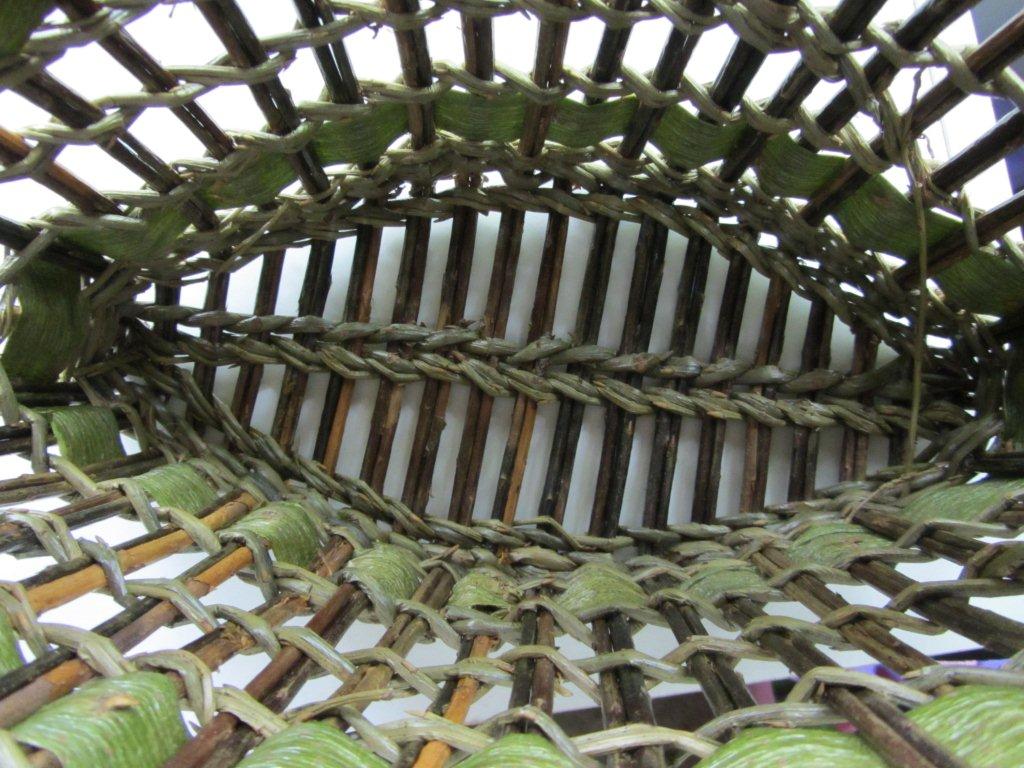
The technique for the magazine basket is also new for me. A scallom is cut at the end of the stakes before they are attached toP6210014 the base which is woven on an oval ring. I like the end result – although I have to admit that I am a bit “knife shy” so the cutting process was somewhat slow for me.

The coracle in the photo at the right was launched in one of the ponds on campus and Poppy Hatinger – who has been involved in a couple of coracle projects – had a lovely presentation for us about the world of coracles and how to make them. Donna Kallner has a few blog postings about it here.

A wonderful trip – worth all the kilometers – spending days with other willow basket makers, teachers, students in beautiful surroundings, learning and making new friends and valuable contacts.

Tuesday, June 5, 2012

Basketry Class with Anne Mette Hjørnholm

On the week-end May 26-27 we had our first serious basketry class here at Lakeshore Willows as the very accomplished Danish basket maker Anne Mette Hjørnholm visited for a 2 day class.
5-29-2012
As I didn’t make sure that I had photos of the finished baskets at the end of the class, I have asked the participating students for photos which I have put together in the above collage.

Here's a purse from another angle. Nice work.


Anne Mette taught 3 different types of baskets. The traditional stake and strand – round basket – was taught beginners, a rib style basket – a hen basket – was made by weavers with a little more experience and a fitched purse was for the very experienced willow basket weavers.
DSC01886DSC01877 DSC01879 
Although 6 of us made a traditional stake and strand basket, not two of them were identical which emphasizes some of the many possibilities this technique offers. Each student decided on their own size, shape, design of weave etc and everyone walked away with a beautiful basket – helped along by Anne Mette’s instructions.
DSC01881 DSC01864
The rib baskets were absolutely beautiful and the fitched purses very elegant and light. The skills and creativity that Anne Mette possesses were obvious and appreciated by all of us as we learned a lot over those 2 days.
Right now Anne Mette is in Stowe Vermont teaching willow basketry all week before she returns to Denmark. This was our first big event – it will not be the last.

Friday, May 25, 2012

END Of THE WILLOW WINTER COLOUR

DSC01172
The season for dormant willow cuttings and rods is over for this year at Lakeshore willows and the last shipments were sent out April 30th.
The beautiful winter colours on the cuttings are slowly fading on the willow that is drying in the barn for basketry.
DSC01193


Soon new colours will be visible in the field as the foliage on the plants start to show.
Rubykins tip, Sept 7, 09

Is your garden too small for planting willows? It may be; but it is also very likely that it is not – you just need to know how to do it.
For ideas on how to ad year round colour from willows to your small garden I will be writing a couple of posts over the next few weeks.

Tuesday, May 8, 2012

HOW INVASIVE IS WILLOW?


I am amazed how often even professional garden writers point out that willow in general is invasive – meaning spreading by sending out suckers that soon will create a thicket of unruly shrubbery.

Personally I do not have any experience with suckering willows – but again, I only have thirty some different varieties of willow here on the farm. To try to get an idea of the extend of willow species with a suckering habit, I turned to one of my favorite books when it comes to more scientific information: “WILLOWS The Genus Salix” written by Christopher Newsholme where the following information can be found:

The genus Salix belongs to the plant family Salicaceae (poplars are the same family) and comprises of some 400 species of willows and more than 200 listed hybrids, popularly known as willows, sallows and osiers. It consists of mainly deciduous trees and shrubs bearing catkins.

The genus consists of three main subgenera:

  1. Subgenus Salix (Amerina), the true willows
  2. Subgenus Caprisalix (Vetrix), the osier and sallows
  3. Subgenus Chamaetia, dwarf, creeping, Arctic or mountain shrubs.

Confusion and uncertainty exists in the taxonomy of this genus and although acknowledging that no method of classification below subgeneric level is entirely satisfactory, Newsholme subdivides the genus Salix into groups and sections intended as a taxonomic guide indicating which species are generally considered to be closely related.

  • Subgenus Salix is divided into 3 groups and a total of 11 sections
  • Subgenus Caprisalix is divided into 4 groups and a total of 14 sections
  • Subgenus Chamaetia is divided into 5 groups and a total of 7 sections.

Of all these sections only one: Subgenus Salix, group 2, section Longifoliae is mentioned to produce suckers from the roots and be thicket-forming. The species in the group are:

  • S. exigua – Coyote Willow
  • S. fluviatilis
  • S. interior – Longleaf Willow or Sand Bar Willow
  • S. melanopsis
  • S. sessilifolia
  • S. taxilolia
  • hybrids between some of the above mentioned species

These species and hybrids are native to western North America. Most of them are described as beautiful shrubs or small trees – but if you don’t want a thicket of willows, don’t plant these in your garden.

Based on this scientific information I conclude that all other species and hybrids of willows will not sucker from the roots and you can safely plant them in your garden.

For further information I refer to Newsholme’s book Willows, The Genus Salix. As I do not grow any willows with root suckering habit here, I don’t have any images to show you.


Wednesday, March 21, 2012

First day of spring - really?

... more like summer. Over 25 degrees celcius here today and everything is oozing summer. The birds are frantic and the frogs in the pond are incredibly loud. Shrubs are starting to leaf out ...

So spring is definitely here and the living willow workshops are on. With this weather I have added this Saturday March 24th to the schedule of workshops so if you cannot wait to garden (but your garden isn't ready yet) come on out and create a masterpiece for the garden.

Words and photos by Lene Rasmussen,Willows.

Tuesday, March 6, 2012

Internationally known Danish willow artist and basket maker at Lakeshore Willows, Wainfleet, Ontario

The very old craft of willow weaving has during the last couple of decades been revived by enthusiastic weavers throughout Europe. More and more people are making this - once a matter of making practical vessels - into an art form creating beautiful baskets, sculptures, huge land art and living willow installations.

The willow craze hasn't hit North America however, and it seems that willow weaving is still taking the back seat to other basketry forms such as rattan reed, grapevine, pine needles, grasses and sometimes other hedgerow materials including wild willow.

We do have very talented willow basket makers and artists in North America, but they are few and even with the help of the Internet can be difficult to find. Even more than that, you often have to travel far to be able to attend a class. 

Examples of Anne Mette Hjoernholm's baskets

Last year on a trip to Denmark I visited the very talented and accomplished basket maker Anne Mette Hjørnholm. Anne Mette is an internationally known willow artist and teacher and will be teaching a 2 day course here at Lakeshore Willows, Wainfleet, Ontario on May 26 and 27, 2012.
The course is structured so beginners as well as intermediate and advanced basket makers can participate and learn at different levels.
The images are all from Anne Mette's gallery and examples of designs for our upcoming class. Please visit her gallery to see more of her beautiful work.

Anne Mette is also teaching classes this year at Stowe, Vermont in June where all her classes are sold out - with waiting lists.

If you are interested in participating in this class and want to know more, please drop me a line at lakeshorewillows at gmail - but you have to be quick as the class is filling up fast.

Words and photos by Lene Rasmussen,Willows.

Sunday, February 12, 2012

Spring 2012 workshops

Living willow workshops for the spring 2012 have now been scheduled. You will have a choice of making the woven "Harlequin tree", the twisted (or roped) tree or both at the workshops.
Kits of rods for both designs will also be available for purchase at the workshops in case you would like to make one or more after you return home.
For more information please look under the tab "Events" at the top of the page.

I am excited to be able to announce the visit here at Lakeshore Willows by the very accomplished and internationally known willow artist Anne Mette Hjørnholm from Denmark. Anne Mette will be teaching a basket class here on the week-end May 26-27 2012 - details to be announced.

This is one example of Anne Mette's beautiful work. If you could be interested in participating, here is a link to the gallery on her web-site. By clicking on an image you will open a related photo album.
Words and photos by Lene Rasmussen,Willows.