Wednesday, October 26, 2011

Flexible Willow Soaking Facility

When I was ready to use my first harvest of willow - dried for basketry - a couple of years ago, I decided to start small and my husband made me two pipes for soaking the willow.
The pipes are resting on a wooden frame in our utility room where the temperature is always around 20 degrees Celsius so it is not a problem to soak willow during the winter months. In the summertime I sometimes move the pipes outside in the sun where the temperature gets much higher which speeds up the whole process.
The pipes have screw caps in both ends. I open one end, fill the pipe with bundles to be soaked and cap the pipe again. Each pipe has a 5cm hole for filling it with water using my garden watering can and for emptying it again siphoning with a thin hose.

This has worked well except for the fact that the pipes are too small if I want to soak willow for more than one project. I really regret that I didn't invest in larger pipes as it can be a little tricky to get the bundles in and out when I stuff as much as possible in there.

This summer my resourceful husband made me a new, very flexible soaking facility.

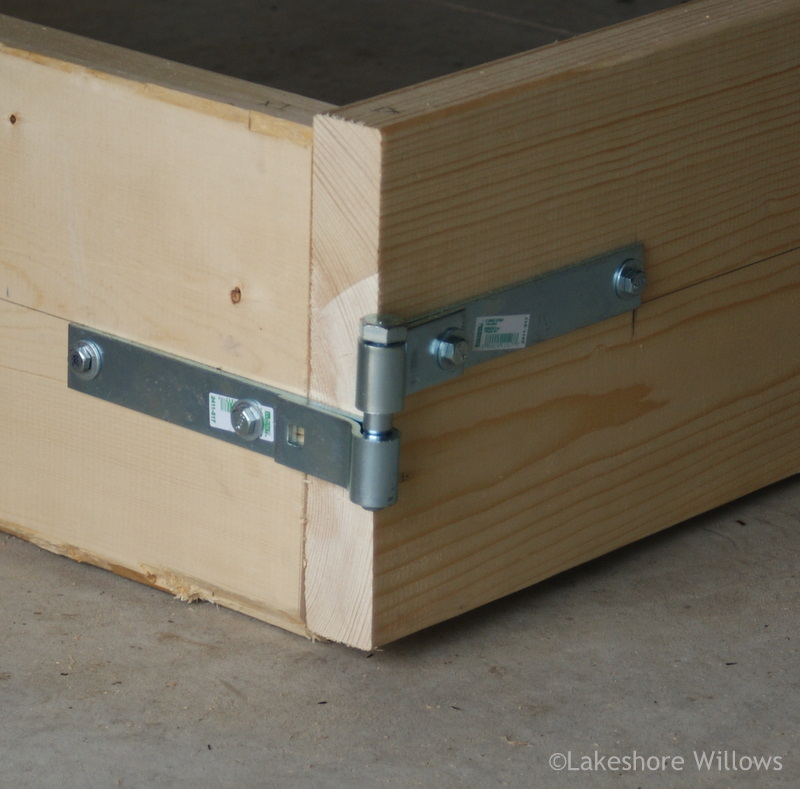
A wooden box that expands as needed. The sides of the box are 8 feet long and the ends are 1, 2 or 4 feet long. The height is 1 foot.
The boards are easily assembled with large bolts.


After the box is assembled, I line it with a double layer of 6 mill plastic. Then I ad just enough water to cover the bottom which makes it easy to smooth out the plastic into all the corners and I can fill it with as much water as needed.


Even though the frame is just 12 inches high, it is amazing how much willow can be soaked in the smallest box.


The willow is weighed down with a few large stones.
Several batches of willow can be soaked without changing the water. It is, however, easy to empty the container for water and afterwards the plastic can easily be cleaned outside on the lawn.

When not in use, the boards require minimal space for storage.

The Danish blog 'Piletossen' has a great, very thorough post about soaking willow. It is written in Danish, but I believe that you can use Google Translate with a decent result.
Words and photos by Lene Rasmussen,Willows.

Wednesday, September 28, 2011

Transplanting your potted willow tree to your garden

As the summer is slowly fading, the colours change and the leaves start to fall, it is time to transplant your potted willow tree to the garden - if you haven't done so yet.


When you first made your tree at our workshop (or bought it) in the spring, the willow rods didn't have any roots yet and you had to leave it in the pot to root and start growing.
It would look like the one in the photo on the left.

When the roots have developed during the summer, you can transplant it to your garden - and by this time of the year you have to do so. First of all the roots may not make it through the winter in the pot above ground, and secondly the woven tree is really 32 willow plants in that little pot - so it really wants to get some more room for its feet.

This morning - still a bit of fog in the air - a woven tree waiting to be planted looks like this one in the photo to the right.
Words and photos by Lene Rasmussen,Willows.

Friday, September 23, 2011

Living Willow Fence - one year later.......

Planting a woven Living Willow Fence has to be one of the fastest ways to create a living wall in your garden.
My woven fence was planted in the beginning of April 2010 and you can see what it looked like by the end of May that same year here.
After pruning in the fall - as I want to maintain the visibility of the shape of the fence - this is what it looked like in mid November the first year.

The following photos are from June this year, the fence being one year old.
If you are not interested in showing the weave, but would rather have a dense hedge, you can at this point weave all the long shoots into the structure.
We don't have a lot of trees on our property, but our neighbour does - and from early afternoon on the hedge is in shade. As you can see, it is doing just fine with the hours of sun that it gets daily.
On the North side of the fence, however the growth is more sparse and you can easily see the woven pattern even at this time of the year. To maintain the fence - so that it doesn't get lopsided - it is important to either prune it at least once (better twice) annually or continually weave any new growth into it.
By the end of July this second growing season the look is very full and the fence is ready for another pruning.
Words and photos by Lene Rasmussen,Willows.

Monday, September 5, 2011

Willow Bird Feeder Classes

My friend Frances - who has a lot of experience working with willow and who is also the treasurer of the Southwestern Ontario Basketry Guild (SOBG) - had talked me into joining her in teaching members of the SOBG to make willow bird feeders.

At the Chatham location - The Chatham Cultural Centre - we had 7 eager members working on their feeders. 
The craft room at the center is large and equipped with lots of tables, chairs and each student had lots of space - which is required for this project.
Sunday's class was held at one of the member's studio in Thorndale. A beautiful space with everything that a basket (or craft) maker can dream of and the 5 students had a great time weaving and enjoying the beautiful view of the gardens and horses in the field. Thank you Linda for hosting this - and your offerings of coffee, tea, wonderful muffins and making sure we were not hungry as we hit the road again, some of us having several hours of driving ahead of us.
I am sure that everyone will enjoy watching the birds that will be frequenting the feeders in months to come.
Words and photos by Lene Rasmussen,Willows

Wednesday, April 6, 2011

Additional workshop available

As my planned Living Willow Workshops for Saturdays have been fully booked, I have added one more session for Sunday April 10, 2011 at 10 a.m.

If you are interested in attending, please send me a mail at salixlene@gmail.com

Words and photos by Lene Rasmussen,Willows.

Wednesday, March 23, 2011

Willow harvest delayed by more snow

Finally last week-end most of the snow had disappeared in the field and we could begin this year's willow harvest.
We managed to harvest about 20% of the rods. Monday and Tuesday I cut a bit more, finished bundeling the rods in the field. By Tuesday  the field was dry enough for me to drive the lawn tractor with my little wagon behind to pick the budles up and take them home.

Then Wednesday morning I woke up to about 10 cm of snow!! And as if that was not enough, it continued on and off all day and by night we have double of that with some drifts as deep as 40 cm - as in the driveway :-)

The next week or so will be cold but sunny and I can only wait..........till it is all gone again - and hope........that I will have time enough to harvest all the willow before it starts growing again.

The bundles look very nice in the snow though and stacked behind the barn waiting to be sorted in bundles with different sizes.


If there is anything good about the snow at this time of the year - yes, they say it is spring and we have changed to "Daylight savings time" - it is the fact that I can let the dogs out without  getting two very dirty, mud dragging boys in the house. Oh well, I tried!!


Words and photos by Lene Rasmussen,Willows.

Monday, March 21, 2011

Working with living willow - workshop in Toronto at TBG

Toronto Botanical Garden has a full program of lectures, certificate programs and events that are open to the public. If you are a member of TBG, you get discounted rates and some lectures are free.
On TBG's web-site you can find information about all their courses and events and you can download the current program guide.

I am very pleased to be involved in one of the adult courses offered by TBG this spring as I will teach a workshop: Working With Willow on April 16, 2011.

After a short presentation about some of all the things that willow is used for (or has been in the past) we will work on making a Twisted Tree to bring home for the garden.

To register for this event, contact the Toronto Botanical Garden. Registration information can be found here.

I would love to see you there.

Words and photos by Lene Rasmussen,Willows.